skip to main |
skip to sidebar
 Announced on Space.com on April 24, 2007, at 4:23pm ET, it has been determined that this exoplanet could support liquid water and possibly life.[ While evidence of liquid water has not been detected, the position of this planet—being in a position that might be within the host star's habitable zone—would allow for water to exist in its liquid state. However, subsequent habitability studies[ indicate that the planet likely suffers from a runaway greenhouse effect similar to Venus, rendering the presence of liquid water impossible.
These studies suggest that the third planet in the system, Gliese 581 d, is more likely to be habitable. Seth Shostak, a senior astronomer with the SETI institute, stated that on two previous occasions, Gliese 581 was looked at as a potential candidate for extraterrestrial intelligence, but both examinations revealed no proof. The confirmation of the exoplanet's position was determined using the HARPS instrument on the European Southern Observatory's 3.6-meter telescope, by applying the radial velocity detection method
Many unanswered questions remain about the properties of exoplanets, such as the details of their composition and the likelihood of possessing moons. The recent discovery that several surveyed exoplanets lacked water showed that there is still much more to be learned about the properties of exoplanets. Another question is whether they might support life. Several planets do have orbits in their parent star's habitable zone, where it should be possible for Earth-like conditions to prevail. Most of those planets are giant planets more similar to Jupiter than to Earth; if these planets have large moons, the moons might be a more plausible abode of life. Detection of life (other than an advanced civilization) at interstellar distances, however, is a tremendously challenging technical task that will not be feasible for many years, even if such life is commonplace.
?
Only two planetary systems have planets that are named "unusual". Before the discovery of 51 Pegasi b in 1995, two pulsar planets (PSR B1257+12 B and PSR B1257+12 C) were discovered from pulsar timing of their dead star. Being that there was no official way of naming planets at the time, they were called "B" and "C" (similar to how planets are named today). However, uppercase letters were used, most likely because of the way binary stars were named. When a third planet was discovered, it was designated PSR B1257+12 A (simply because the planet was closer than the other two). Some nomenclatures (generally in science fiction) use Roman numerals in the order of planets' positions from the star, but for the above reason, this is not practical. If the planet orbits in a non-circumbinary system, the letter of the star is added to the name.
The star 55 Cancri is the star with the most confirmed planets found around any star known (excluding the Sun) and may contain more planets. The planet 55 Cancri f (artist's conception pictured) is currently the only planet with the designation "f"

If the planet orbits the primary star of the system, and the secondary stars were either discovered after the planet or are relatively far form the primary star and planet, the name is usually omitted. For example, Tau Boötis b orbits in a binary system, but because the secondary star was both discovered after the planet and very far from the primary star and planet, the term "Tau Boötis Ab" is rarely to never used. However (in the cases of 16 Cygni Bb and 83 Leonis Bb), if the planet orbits a secondary star of the system, the star's name is always used. Some planets have received unofficial (informal) names that can be compared to the planets of the Solar system. The most noted planets that have been given names include: Osiris (HD 209458 b), Bellerophon (51 Pegasi b), and Methuselah (PSR B1620-26 b). The International Astronomical Union (IAU) currently has no plans to officially name extrasolar planets, considering it impractical.
The first published discovery to have received subsequent confirmation was made in 1988 by the Canadian astronomers Bruce Campbell, G. A. H. Walker, and S. Yang. Their radial-velocity observations suggested that a planet orbited the star Gamma Cephei. They remained cautious about claiming a true planetary detection, and widespread skepticism persisted in the astronomical community for several years about this and other similar observations. It was mainly because the observations were at the very limits of instrumental capabilities at the time. Another source of confusion was that some of the possible planets might instead have been brown dwarfs, objects that are intermediate in mass between planets and stars. The following year, additional observations were published that supported the reality of the planet orbiting Gamma Cephei, though subsequent work in 1992 raised serious doubts. Finally, in 2003, improved techniques allowed the planet's existence to be confirmed. In early 1992, radio astronomers Aleksander Wolszczan and Dale Frail announced the discovery of planets around another pulsar, PSR 1257+12. This discovery was quickly confirmed, and is generally considered to be the first definitive detection of exoplanets. These pulsar planets are believed to have formed from the unusual remnants of the supernova that produced the pulsar, in a second round of planet formation, or else to be the remaining rocky cores of gas giants that survived the supernova and then spiralled into their current orbits. On October 6, 1995, Michel Mayor and Didier Queloz of the University of Geneva announced the first definitive detection of an exoplanet orbiting an ordinary main-sequence star (51 Pegasi). This discovery was made at the Observatoire de Haute-Provence and ushered in the modern era of exoplanetary discovery.
Technological advances, most notably in high-resolution spectroscopy, led to the detection of many new exoplanets at a rapid rate. These advances allowed astronomers to detect exoplanets indirectly by measuring their gravitational influence on the motion of their parent stars. Several extrasolar planets were eventually also detected by observing the variation in a star's apparent luminosity as a planet passed in front of it.
To date[update], 348 exoplanets have been found, including a few that were confirmations of controversial claims from the late 1980s. The first system to have more than one planet detected was Upsilon Andromedae. Twenty such multiple-planet systems are now known. Among the known exoplanets are four pulsar planets orbiting two separate pulsars. Infrared observations of circumstellar dust disks also suggest the existence of millions of comets in several extrasolar systems.
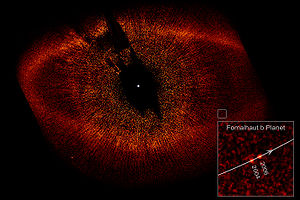
 An extrasolar planet, or exoplanet, is a planet beyond our Solar System, orbiting a star other than our Sun. As of May 2009[update], 348 exoplanets are listed in the Extrasolar Planets Encyclopaedia.a The vast majority have been detected through radial velocity observations and other indirect methods rather than actual imaging. Most announced exoplanets are massive gas giant planets thought to resemble Jupiter, but this is a selection effect due to limitations in detection technology. Projections based on recent detections of much smaller worlds suggest that lightweight, rocky planets will eventually be found to outnumber extrasolar gas giants. Extrasolar planets became a subject of scientific investigation in the mid-19th century. Many astronomers supposed that such planets existed, but they had no way of knowing how common they were or how similar they might be to the planets of the Solar System. The first confirmed radial velocity detection was made in 1995, revealing a gas giant planet in a four-day orbit around the nearby G-type star 51 Pegasi. The frequency of detections has tended to increase on an annual basis since then. It is estimated that at least 10% of sun-like stars have planets, and the true proportion may be much higher. The discovery of extrasolar planets sharpens the question of whether some might support extraterrestrial life.
Currently Gliese 581 d, the fourth planet of the red dwarf star Gliese 581 (approximately 20 light years from Earth), appears to be the best example yet discovered of a possible terrestrial exoplanet that orbits within the habitable zone surrounding its star. Although initial measurements suggested that Gliese 581 d resided outside the so-called "Goldilocks Zone", additional measurements place it firmly within
Extraterrestrial life is defined as life which does not originate from Earth. It is the subject of astrobiology and its existence remains hypothetical, because there is no credible evidence of extraterrestrial life which has been generally accepted by the mainstream scientific community. Hypotheses regarding the origin(s) of extraterrestrial life, if it indeed exists, are as follows: one proposes that it may have emerged, independently, from different places in the universe. An alternative hypothesis is panspermia, which holds that life emerges from one location, then spreads between habitable planets. These two hypotheses are not mutually exclusive. The study and theorization of extraterrestrial life is known as astrobiology, exobiology or xenobiology. Speculated forms of extraterrestrial life range from life at the scale of bacteria to sapient or sentient beings.